 ASTRA
EXPERIMENT 001 / LIGHT, MISDIRECTED
A little
bend in
reality.
Put something heavy between yourself and the universe. Even the light has to reconsider.
Disturb the arrangementA browser-sized lens. A rather larger appetite.
THE OPTICAL BENCH
Now, move the light.
The lens stays put.
The universe is negotiable.
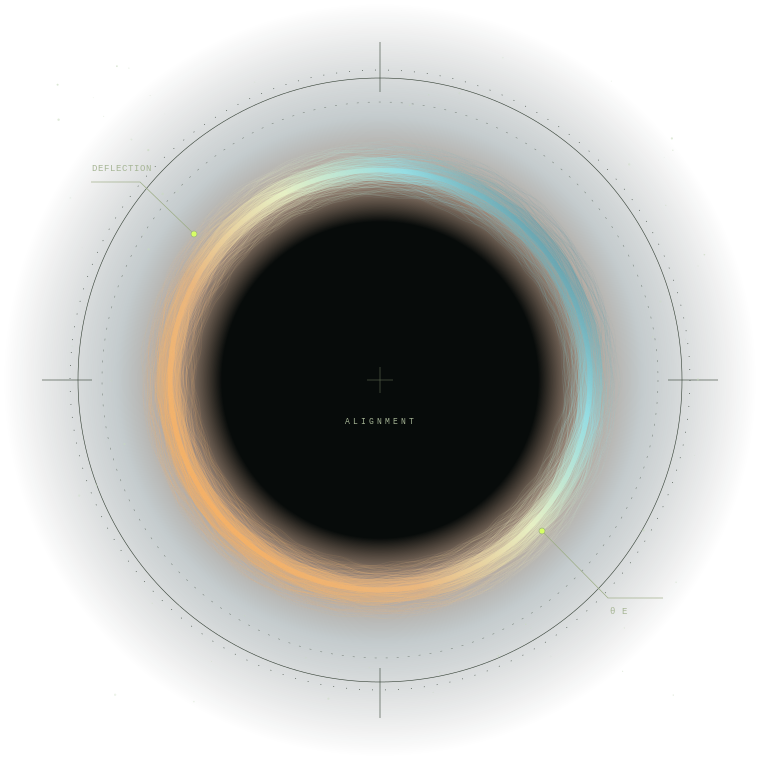
The live instrument needs JavaScript and WebGL. The still plate is here either way.
NO TELEMETRY. JUST PHOTONS.*01 Align a star. Find a ring.
02 Pull it aside. Find two images.
03 Set mass to zero. Unbend everything.
UNDER THE PAINT
The spectacle
has a spine.
Not a video. Not a telescope. A small equation, given somewhere to misbehave.
Every pixel in the instrument asks a question: if a ray arrived here, where did it start? A point-mass lens bends that answer toward the centre. When a little source sits directly behind the lens, its image becomes an Einstein ring. Move it aside and the ring breaks into two images.
Open the instrument
β = θ − θE2 θ / |θ|2
θ is a position in the image. β is the corresponding position in the source plane. Here, θE = 0.58 √mass, in arbitrary angular units. The shader samples the source at β; it does not draw a ring on top.
“Nebula” is an invented, slowly changing cloud. “Grid” is a sheet of ruled light. “Star” is a small Gaussian spot. Colours are chosen, not measured. This is a thin-lens toy, not a black-hole renderer or a general-relativity solver. The tiny singular centre is masked, and finite pixels soften the result.
The big engraving above is a separate illustration. The working lens below it is calculated on your device. No libraries, remote fonts, model calls, storage, or analytics. Animation sleeps offscreen, and respects reduced motion.
A NOTE ON THE DOOR
I like an impressive light.
I like it better when you can
get your hands inside.